Lost in translation
Who is responsible for creating understanding?


Most of the literature I've read in recent months is work in translation. In the book I just finished, I found myself pausing often to marvel at particular choices of words, at the cadence or rhythm or consonance in a passage, at the evocative scenes constructed from particular building blocks of sentences and clauses.
My immediate reaction was to appreciate the author, thinking how artful he was and how clearly his vision was communicated directly to my senses; my secondary reaction was to realize that, as a work in translation (and sometimes in translation of translation), those choices were obscured and mediated through another voice; my third reaction was to consider how talented the translator must be, to wield multiple languages and allow the author's vision to shine through; my fourth reaction was self-doubt: how could I possibly know or attribute whose efforts combined in which ways to produce the outcome I experienced; and my fifth reaction was a sense of simultaneous wonder and melancholy, thinking of how much we don't get to witness in others' experience because of the barriers of time or language or culture, how lucky we are to live in an era where translation is more feasible than it ever has been, and how perilous it is to exist in an age of technology that gives a false sense of certitude that our translated experiences reflect not only a unified (or at least representative) experience, but also what was intended in the first place.
Ann Goldstein recently spoke about her experience translating Italian literature into English, and her conception of translation as a possible feminist practice and a tool of civic engagement. Goldstein notes that what is subject to translation (and whose works) mark political choices, but how translation occurs, and what choices the translator makes using their own cultural knowledge and inventive style, also shape the legibility of the original author and work. The translator's choices, too, are a function of their time and context, and can make access to particular works feel stale or outdated if re-translations do not occur at regular intervals.
Those revelations might seem obvious, but in the span of a brief interview, Goldstein makes evident the relational nature of translation. Transiting someone's ideas across time and cultures, communicating someone's prose through the prism of different semantics, requires being in relationship to the original work, its original author, its context and meaning—everything explicit and implicit about it. But it doesn't require sublimating yourself, your own thoughts and experiences and ideas and interpretations (and in fact, doing so is perhaps an even greater disservice).
Goldstein's claim of translation as a feminist act is (to my mind) pretty disappointingly one-dimensional: she translates mostly women, women's voices are underrepresented in literature, ipso facto: feminism. For me, instead, it recalled several moments in the famous tracts collected in This Bridge Called My Back, originally published in 1981. In the titular and iconic "The Bridge Poem," Kate Rushin says:
I've had enough
I'm sick of seeing and touching
Both sides of things
Sick of being the damn bridge for everybody
Nobody
Can talk to anybody
Without me
Right?
Translating across space, time, race, gender—all of this is tiresome, she contends. "I do more translating / Than the Gawdamn UN / Forget it / I'm sick of it / I'm sick of filling in your gaps," she says. Her isolation is not just feminized ("I will not be the bridge to your womanhood / Your manhood / Your human-ness") and racialized ("the sole Black friend to 34 white people"), but also ideological (translating "the ex-hippies to the Black separatists"). "The bridge I must be," she concludes, "[is] the bridge to my own power."
The work of translation from author to audience requires skill, but also carries an exceptional burden—one that, maybe, is impossible to do without self-effacement.
Later in the volume, Gloria Anzaldúa shares her letter to Third World women writers, with the project of transcending the hollow, intellectual language taught her in school to communicate with an intimacy instead. "Because white eyes do not want to know us," she writes, "they do not bother to learn our language...." Yet at the same time, women of color writers "have strung degrees, credentials and published books around our necks like pearls that [they] hang onto for dear life," threatening to sideline each other or sell out entirely. Communicating with the tools imposed on you offers the prospect of validation, but at the cost of integrity and authenticity. Having been inculcated in a language, method, or style of writing, though, how can you banish it fully from your practice?
The tension Anzaldúa points out is palpable throughout her letter: feeling impelled to write but knowing that writing might do work that isn't her own, feeling a desire to connect to others but not abandon her own experience in the process. She offers:
The danger in writing is not fusing our personal experience and world view with the social reality we live in, with our inner life, our history, our economics, and our vision. What validates us as human beings validates us as writers. What matters to us is relationships that are important to us whether with our self or others. We must use what is important to us to get to the writing.
The encouragement, then, is to pursue writing as the process itself. The compulsion to write as an act of self-discovery has the potential within it to resist assimilating to "social reality" or the requirements of whiteness. Writing is inspired by values that run deeper. It doesn't require a "room of one's own" or any of the edicts and artifices of dominant culture, not really. Anzaldúa continues her admonishment:
Write with your eyes like painters, with your ears like musicians, with your feet like dancers. You are the truthsayer with quill and torch. Write with your tongues of fire. Don't let the pen banish you from yourself. Don’t let the ink coagulate in your pens. Don't let the censor snuff out the spark, nor the gags muffle your voice. Put your shit on the paper. We are not reconciled to the oppressors who whet their howl on our grief. We are not reconciled.
Anzaldúa ends here: don't trade your talent and heartfelt need to write for the possibility of recognition in publishing. That is, don't contort your narrative for the sake of acknowledgement by or communication with an audience who didn't want to understand you anyway, an audience that wasn't interested in or willing to bridge that gap in the first place.
The author, then, is the first translator. She selected words, elements of the story, style, and medium. She did work to bridge the lossy process between thoughts, feelings, experience on the one hand, and cold, lifeless paper on the other. Any second translator can only pretend to a level of understanding, and necessarily is doing interpretation in the process.
Kafkaesque by Maïa Hruska just came out barely two weeks ago, and I've already devoured it twice: once at my normal 1.7x speed and a second time at 1.2x, which is one of the highest compliments I can offer a book. It traces the lives and intersections of ten translators of Franz Kafka's work, meditating on how each of them undertook the tasks of translation, as well as how the languages they wielded shaped their (and our) understanding of his work. With their varying perspectives and experiences and transmutations of Kafka's prose, "perfect alignment becomes structurally impossible," she writes. Even though the source material is the same, the interpretations and communications of it through language and time express variance in a way that doesn't betray the original, but rather shows its depth and resonance.
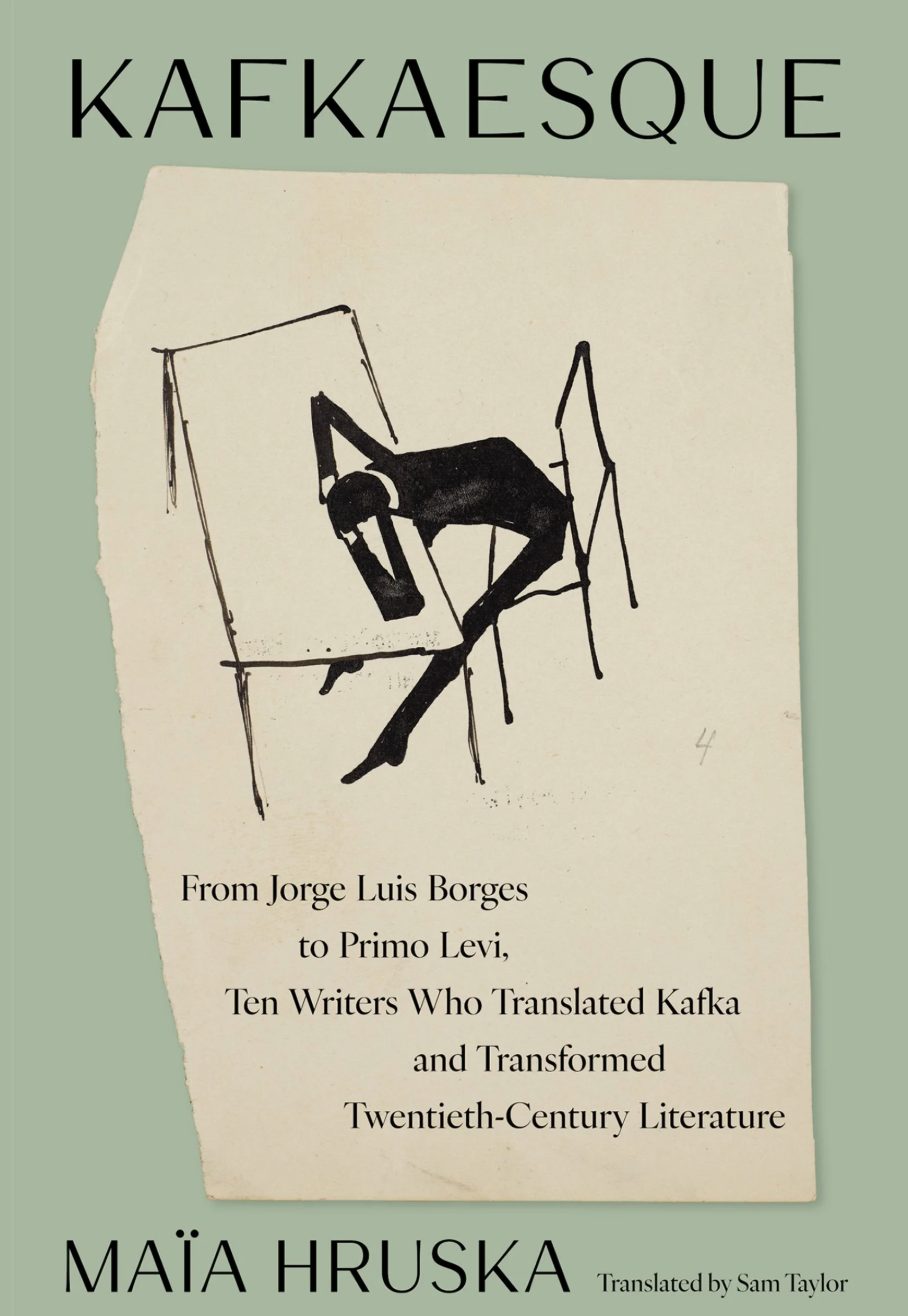
Later in the book, Hruska describes Hannah Arendt's dismay at Eichmann's trial in Jerusalem, whereupon she discovered just how "poor quality" the official translators were, between the court's Hebrew and Eichmann's German. The surface-level explanation, per Hruska, is that Israel's education system no longer taught German in the 15 years or so after the end of the war, and that fluency in Hebrew legal jargon was not common even among those recruited. But beneath this logistical and practical barrier was an emotional one: imagine having to translate some of the most horrific crimes against humanity, to find not only the words to convey the literal acts but to have to hold and carry them, transmit and transmute their meaning and their impact, in close-to-real-time. "What the interpreters were experiencing was incommunicability in its most radical form. This was not word-for-word translation, but hand-to-hand combat," writes Hruska.
The translators and interpreters she chronicles in the rest of the book don't really escape this same fate, each contending directly with the challenging and unsettling themes Kafka put forward in his works, some at great cost.
What the interpreters were experiencing was incommunicability in its most radical form. This was not word-for-word translation, but hand-to-hand combat.
— Maïa Hruska on the experience of translation during Eichmann's trial, Kafkaesque
It's worth noting, though, that Kafka never intended for his later works to be published. He entrusted his friend, Max Brod, to destroy his writings after death. But Brod disobeyed. We're all indebted for the opportunity to engage with some of the most paradigmatic works of surrealism (and absurdism, and existentialism) to ever exist. But that Kafka never intended to publish these writings makes you wonder: was there ever an imagined audience? If not, what would our interpretations and experiences of the texts even mean?
Even the opening line of The Metamorphosis has elicited diverging interpretations and defied direct translation. Without a definitive nod from the author, all that exists is an expanse of interpretation and fun-house mirrors of meaning. Kafka's meaning can be his own; yours is up to you. Another radically existentialist and absurdist turn.
Many a modern thinkpiece decries the "division" in modern society, bemoans partisanship and the disintegration of cultural or ideological unity, denigrates overly "extreme" thoughts and ideologies. There's an imagined "truth" that lies somewhere in the center of every set of disparate opinions, as though moderating all interpretations and muting every dial somehow creates a soft landing place for honesty and clarity.
They're all wrong, by the way.
There isn't a universal truth to be found, in a soft bed of gentle words or otherwise. There's a truth each of us will have, a set of truths that can coexist together socially, and some truths too far afield to be incorporated into a common fabric.
The imagination that we should strive for unity often asks us to seek understanding from each other. But whose responsibility should it be to recover and create that understanding? Whose body or mind or soul is supposed to serve as the bridge between our disparate realities? Translation is a noble task, but never a complete one. It relies at least in part on a belief that the words are worth translating, worth being heard or read (maybe even understood). It also relies on the belief that the translator can be a faithful steward and an effective conduit for the original work: its phrasing, but also its intentions, meaning, and even its ambiguity.
You might be your own most faithful translator. For other individuals with whom you share relationships and a basis for understanding, or for wider audiences. Who should know better than you what you're really thinking, feeling, or wanting to say?
Anzaldúa's intervention here should give you pause. When you're saying things for others to read, consume, witness—why? How does the knowledge of your audience shape your own self-expression? How does it force your hand in twisting your letters to make different sounds for others' ears? Does preemptively addressing your audience give your words better shape, something more easily consumed and processed? Does that ease create a better basis for relationship, understanding, partnership?
Or. Is that the beginning of twisting the words inside yourself, reshaping your insides to fit others' expectations, constructing your tower of toothpicks into a gentle narrative that is meticulous and digestible, but too fragile to hold a powerful core?