We have a Prairieland verdict. What now?
The Prairieland verdict is devastating. But the takeaway message may not be what you think it is.

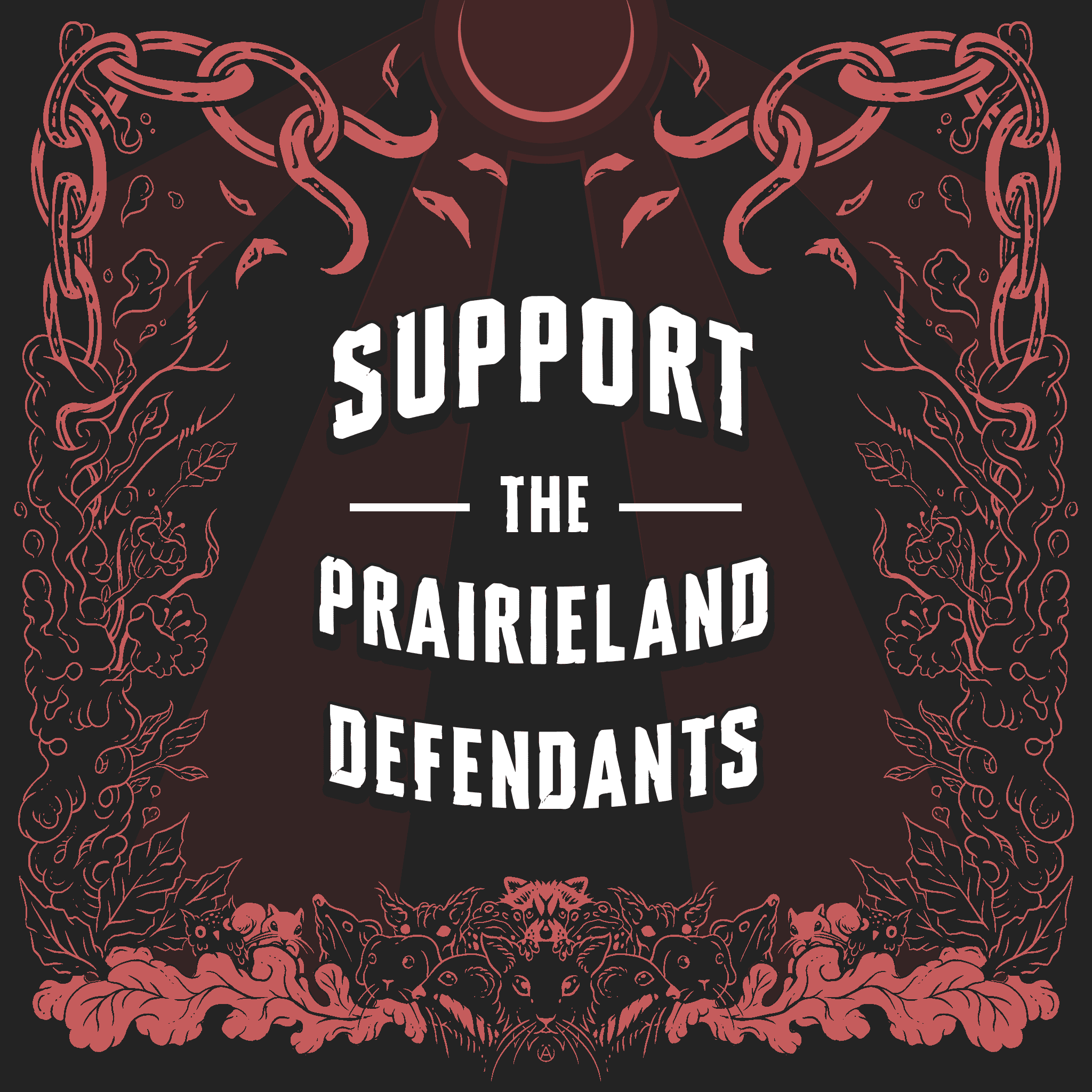
I was holding my breath for the Prairieland verdict without even realizing. Holding gentle tension in my diaphragm about... something... as though that could prevent some kind of harm, just to have the wind sucker-punched out of me when the decision came down on Friday.
8 defendants (all but Des) declared guilty of riot, material support to terrorism, conspiracy to use & carry an explosive device, use & carry an explosive device.
— DFW Prairieland Support Committee (@dfwsupportcommitt.bsky.social) March 13, 2026 at 3:38 PM
It's not that I expected some sort of resounding "victory" outcome, but it is true that despite my general lack of optimistic disposition, I thought the probability that we wouldn't see sweeping guilty verdicts was at least moderate.
Don't misunderstand: many reactions immediately after the verdict were quick to conclude "THIS IS FASCISM." And that's not wrong, but it's unsatisfactory and incomplete. Many things about how the US has functioned have been fascist for a long time, and whether and how much you were likely to encounter those fascist currents depends and depended so much on your embodiment, history, and lived experience. Immigrants, people of color, people without generational wealth—all of these are and were more likely to see the fascism and name the fascism.
And. It is not less scary to have mask-off fascism or naked pronouncements of authoritarian intent. I'm not an accelerationist (because empirically that does not work the way you'd think) and not holding out hope that verdicts like these snap people into a new shared reality that somehow means we succeed in finally coalescing a powerful force against government aggression. Prior beliefs are extremely strong, and even if this is a wake-up call for some, for many others it will just feel like a confusing aberration from a norm they believe still exists (ever existed).
Even the language in some responses to the verdict, calling it the result of a "sham trial," suggest that we ever really had a functioning judicial system for everyone involved, or that the US government or criminal-legal system were, at some point, effectively constrained by civil authority. It's probably true that there was often less blatant overreach than in this case, but you don't have to look hard to find far-reaching and devastating impacts of our supposed "justice" system on people's lives.
My point is, for many, this verdict won't be the force that lifts the wool from the eyes or spurs people to action. In many cases, I think, it could serve the opposite function.
I'm not a lawyer, but the implications of this case hold echoes of discussions that happened around the Stop Cop City trial and RICO indictments. In that instance, one of many worries was that RICO charges pertaining to activities like handing out flyers would create a chilling effect even on above-ground organizing. If offering up donations and mutual aid through standard public channels, or engaging in what has often been thought of as constitutionally protected free speech protest activity, could ensnare someone in legal troubles related to "conspiracy" or "racketeering," or in the Prairieland case, "terrorism," why would any well-meaning liberal folks ever take the risk?
That's essentially the take Xavier de Janon, the Director of Mass Defense at the National Lawyers Guild, offered in this Dallas Observer piece explaining the case in the lead-up to the trial:
This precedent could result in people facing terrorism charges for doing very simple mainstream activism.
This type of pressure on and against "mainstream" activist activities cuts both ways. When the state essentially declares that any action associated with resistance could be construed as terrorism, a large number of people will decide that that makes the costs of their participation too high. They have lives and jobs and families and dreams, and don't need the $20 they would give to a mutual aid project to jeopardize all of that when they could just go on living a life only really impacted by inflation and some general bad feelings.
But it also has the potential to create the opposite impetus: if the costs are the same whether you donate $20 to mutual aid or transport a box of zines or exist in a Signal group chat, or whether you carry out serious and impactful direct action against government entities, some people will decide that being implicated in "criminal" or "terroristic" activity is now unavoidable. The marginal cost of additional actions has been reduced. Even more than that, participating in activities associated with antifascism could become a more credible signal of your commitments and principles because of a willingness to take on potential legal costs.
What happens now that the Prairieland case has been decided?
As I said, I'm not a lawyer, so I'm not qualified to speculate about legal ramifications or next steps. What I do want to talk about, though, are some key insights that you, a person who perhaps has been sympathetic to anti-ICE organizing, or who is concerned about US government overreach, might glean from how the trial unfolded.
Takeaway 1: Evidence that you're "doing the right thing" has nothing to do with the law
There's no time like the present to revisit any latent assumptions you might have about what it means to have a criminal record, or to ever have been accused of a crime. Laws are emergent, not just from values and norms, but also from the intentions and needs of powerful people and institutions to maintain a concept of "order" or "control."
For folks who are still hanging out in the mental position of there being a "right way" to protest, or a need to behave with decorum, this verdict should be another penny on the scale that makes you question your position. Not because you must agree with everything that the defendants allegedly did or how they conducted themselves, but because you can see how a government and its representatives can attempt to (mis)construe any behavior for the purposes of taking broader strategic actions.
On the flip side, then, when you yourself are deciding how you should act in your political environment, laws and legal regimes should play into your consideration insofar as they dictate some of the costs and risks, but not in the sense that they carry unique, overriding moral authority.
Takeaway 2: Sometimes things (and people) are messy—plan accordingly
One of the most common rejoinders in the social media reaction to the verdict was the idea that "one asshole" (Song) used a firearm and therefore implicated everyone else in something (attempted murder) that otherwise would have been totally above-board.
I would urge you to resist that framing as a general rule. The state doesn't need extra help making their case, and you aren't on their payroll, for one thing. For another, this disaggregation of the defendant group is just setting up the "good protestor"/"bad protestor" dichotomy again, dressed in different clothing.
Whether and what was premeditated or intended isn't my business, my purview, or my concern here. Even the best laid plans (or lack thereof) run into random chance, unexpected friction, and unanticipated interactions. So by "plan accordingly," I do not mean "if only this were better planned, nothing bad would have happened."
What I do mean is, knowing that you can't plan for every possible thing that could happen changes your sense of the risks and benefits. And right now, in this political moment, when those stakes are being quickly renegotiated, is exactly when you should start to get real with yourself. How well do you know your own intentions, the people you're with and their commitments, and the potential impact of your actions?
Takeaway 3: Material conditions weigh on your values
Perhaps the second most common reaction among social media discourse surrounding the case centered on the role of cooperating witnesses, and renewed debates around "snitching." I'm not going to weigh in on pros and cons here, but I will remind us all that anyone's material conditions (their livelihood, their family, what they have at stake) can be weaponized against them by states and authorities. Values and ideals matter, but they aren't always going to be the final bastion; everyone's math is different.
It's one reason why it matters to really know and vet people if you're taking risky direct action with them. Knowing what to expect of them and how they behave lets you know what kinds of risks they're likely to take on for themselves (and which risks you might incur by association). It'll also give you a sense of whether you'll be able to remain a collective front against the threat of punitive institutions, or whether any collective goodwill could fracture.
But more than that, it should be a signal to you to check in with yourself about your hard lines, your risk appetite, the costs you can take on and the threats you can withstand. Because knowing that about yourself is a critical foundation for offering and building trust with others. Without that trust, no actions are fully scoped. How costly that is to you is then entirely down to how risky the action is.
Takeaway 4: Legal precedent still matters
Even when it's not a source of total moral authority, law and legal precedent are important organizing characteristics for society and for state authority. Yes, it's dangerous and scary for our legal institutions not to hold sway as a check on authority the way that we were perhaps raised to expect, but the fact that the state appeals to legal conclusions at all, rather than pursuing... simpler and more violent alternatives... indicates that institutionalized authority is still considered an asset to the regime.
That doesn't necessarily mean that we all just twiddle our thumbs and wait for the ACLU to work it out (or something). What it could mean, though, is something about our time horizons. Dismantling institutions isn't often done completely overnight. Sometimes there's slow erosion, sometimes there's an acute event that brings about a discontinuity. But keeping an eye on the opportunistic legal precedents, the cases that states and governments decide to pursue and the stakes they set, gives an indication of what groundwork needs to be laid for any strategic future outcomes. In a time when everything is in flux, these types of observable implications of needs and strategy might be all we get to plan accordingly.
What's next?
I don't have a grand concluding statement for you about what this all means or what you should do. Surely folks more informed than I will have written more by next week, and I'm happy to pass that along, but overarchingly what I wanted to offer is this:
You don't need to be swept up only in the minutiae of this case or its nitty gritty legal and political implications. You can use it as an opportunity to slow down and engage in some self-reflection. Does this update your sense of our political environment? If it does, what changed? If it doesn't, what's the same? With that perspective, how will you change your behavior? With your emotional reaction to this verdict (and, you know... ~ gestures broadly ~), what do you need in order to keep moving? What actions do you need to take or relationships do you need to forge or plans do you need to put in place or information do you need to seek out?
Yes, everything feels scary and dire and urgent. But it's also true that the same themes play out again and again: how we can work together (and when we can't), what aims we're trying to achieve and the best pathways to get there (according to whom?), and what the consequences and impacts of our decisions and actions might be.
Keep going.
Links'n'Things
It feels like Iran news moves both very quickly and very slowly, and that keeping an eye on developments on multiple fronts is increasingly untenable as our media environment further disintegrates. If there are things you're wanting to find deep dives on or more coverage about, though, I'm happy to investigate further—just comment or reach out directly!
Stuff you might've missed
- More about Prairieland
- About those DOGE deposition videos from hell...
- Photos of the aftermath of Israeli attacks on Iran, and the scene around Beirut right now
The Good Stuff™
- Want to hear Chris Bumstead, 6-time Mr. Olympia bodybuilding champion, lay down some real honesty?
- If cabbage has one champion, I am that champion. If cabbage has no champions, it means I have passed.
- This series by Nour Haïdar hits

![[RRPG] Use your voice, or exit stage left?](/content/images/size/w600/2026/02/photo-1591261495530-262c58c5f31a.jpeg)