Pathways to political life
Invest in your political education. Hone your political skills. Burn down the world that doesn't serve you. Build a new world that frees us all.

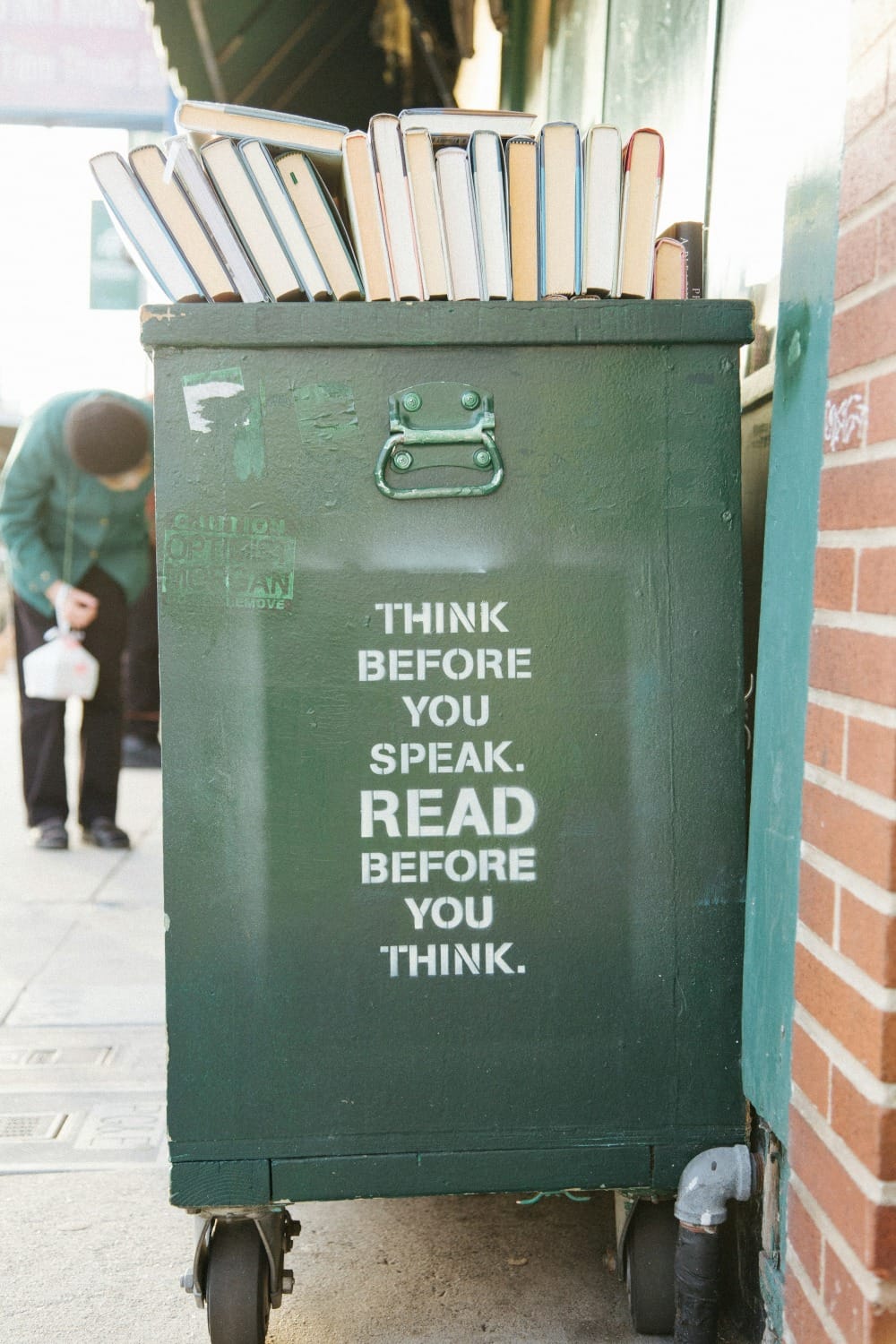
No one is born with political intuition—it's a skill that requires practice. It's shaped by our circumstances and shapes them in turn. There are a lot of pathways to political life and political awareness, but all of them require intention and action. They aren't something bestowed upon you.
If you're reading this, you probably have already had some political awakenings. Do you remember the first one? The first moment you really stopped and thought, "wow that's fucked up, why is that happening?" Do you remember what you did next? Did you investigate the thought or push the feeling down? Did someone help pave your way by giving you time, energy, resources, a listening ear?
It's easy to feel at a loss for what to do right now. It's also easy to feel a ringing in your ears while you witness what's happening and feel disappointed in the reactions it's getting (or not getting). Whether it's your first rodeo or not, this global political moment is rife with opportunity for political (re)awakening, if you want it.
It's also easy to lose compassion for people whose circumstances didn't require them to develop political cunning or awareness of power. And it's easy for that judgment to turn into shame when we ourselves fall short of our own expectations for political awareness. But neither of those serves our aims of developing our political skills and refining our unique political voices. They just keep us stuck and searching for little oases of moral superiority. So what's the alternative?
Intention. Investment. Concerted effort. Action. Rinse and repeat.
Announcing: the Radical Reading + Practice Group
This is where the Radical Reading and Practice Group (RRPG) comes in. I've talked to so many people who are feeling various levels of overwhelmed, burnt out, defeated, and exasperated in the last few months. All of them are people with political sensibilities and justice orientations, but who feel isolated and disconnected, or unsure if their tried-and-true tactics for contending with our political environment can really rise to the needs of this moment.
We are (we have been) well beyond the "I'm listening and I'm learning" stage, so it might feel trite for me to offer up "have you thought about reading a book?" right now. But hear me out:
If you're like me (like many), you might be scrambling all over our algorithm-laden feeds trying to locate credible news about what's happening. You might be searching for someone, somewhere, who is making sense of it all. You might be feeling a lot of urgent emotions and scattered thoughts pressing too hard on the inside of your skull with nowhere to go. And the din of social media hot takes isn't helping; it's not creating connection, community, and collective action, but is instead creating a race to the bottom for quickest quips and morally superior angles.
This moment feels unprecedented, loud, and acute. But it isn't. People just like us have been here before. They've had thoughts, created frameworks, learned lessons, philosophized, and reflected. Seeking those insights with intention, approaching them with intellectual curiosity, and engaging them deeply—these are the ways that political education can really support you right now. Not reading a book to find "the right answer" for what to think or how to feel or what ways to act. But rather, reading to:
- tease apart insights and entertain new perspectives
- tear down ideas and reconstruct your own from their building blocks
- listen to other voices in order to get more in touch with your own
- form a basis of understanding across time and space
- fortify your mental frameworks of what is happening and why
How does it work?
RRPG is designed as a monthly offering through this very newsletter. In addition to getting all of the regular content from Evidence & Evil, you'll also get a monthly deep-dive on a suggested reading, along with a reading guide that includes questions for you to ask yourself or to discuss with friends. Each edition will also feature an audio (or video!) podcast-style mini "lecture" to help ground you and give context to the reading. You'll have access to join in on the conversation by commenting, asking questions, and requesting future content.
And perhaps most critically, it doesn't end with just reading and reflection. My genuine belief is that there's a huge gap between political intuition, political education, and action—and I want to help you build the skills you need to move toward action from a thoughtful, reflective, and grounded place. So as someone doing the work on your political education with the readings, you'll also get early access and special pricing for practice group sessions. These sessions will be virtual and/or in person throughout the year, focused on specific topics and skills each time—whether that's helping you build and use your political voice in conversation or writing, helping you form connections and mediate conflicts, or helping you navigate your political information environment with discernment.
In short: it's an asynchronous learning opportunity with a monthly cadence, and how far you take it to build your political practice in action is up to you.
Who is it for/not for?
If you're not someone who reads, you probably are already gone by now 🙃 And perhaps it goes without saying that the Radical Reading and Practice Group is not designed for people who don't enjoy reading long-form essays, books, chapters, or treatises. But if you enjoy digging in and really interrogating a reading, picking it apart, and mulling it over—you're someone who will probably get the most out of RRPG.
Not all the readings will be heavy and dense, but some might be. As a former professor and academic, I've encountered so many enlightening, meaningful pieces of writing over decades, and some of them are deeply relevant right now. But! Having a college education or fancy degrees isn't a prerequisite for any of the works we'll talk about. I'm not selecting anything that requires you to have a significant amount of background knowledge or training, but (and this is an important but): sometimes readings will come from unfamiliar perspectives, eras, or styles; some will have been written for audiences that don't look like you or sound like you; some will have more engaging prose than others. You might not understand everything you read on a first pass (or a second or a third!) and THAT'S OK.
You'll get the most out of RRPG if you're excited and open to new ideas, willing to be patient with readings and questions, and able to practice inward kindness and outward curiosity when things are just beyond reach. Part of the goal here is to stretch ourselves a little so we can get to the bottom of how we're feeling and what we truly think—myself included!
Sneak preview: Exit, Voice, and Loyalty
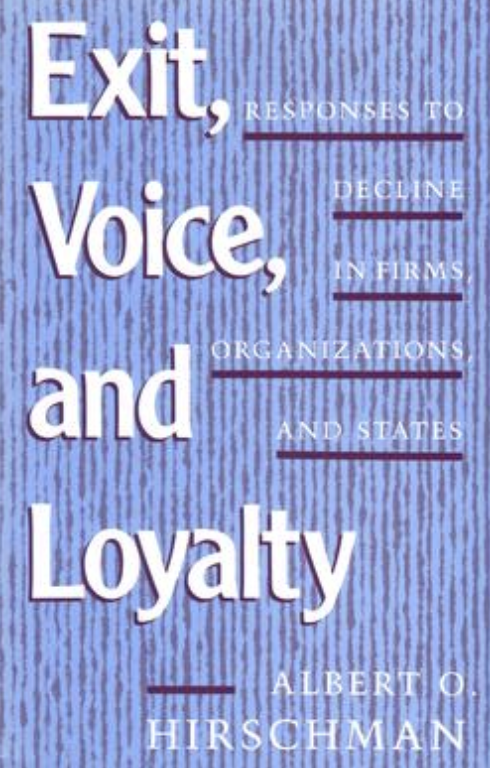
Enough speaking in generalities, though, let's get specific 🤓 RRPG will go for the entire year, with the selection of readings shifting over time (and with your input!). But spoiler: we're starting next week with an excerpt from Exit, Voice, and Loyalty.
Why Exit, Voice, and Loyalty for right now?
Exit, Voice, and Loyalty is a short series of essays written in 1970 (a seemingly disparate time period, I know) examining the choices that consumers and political actors alike have as they operate within organizational constraints. As the title suggests, when confronting a decline in the quality of goods and services, actors have two primary actions available for dissent: exit and voice. But this doesn't just apply to economic markets—it allows us to evaluate our political options and actions, too.
This tradeoff extends from organizational economics to political life and social groups because actors in all these systems must fundamentally decide whether to comply or push for change. The framework is broadly game theoretic, but without the extensive mathematical formalization more common in contemporary economics. That might sound dry, but the benefits are huge when we're trying to think through something as complex and messy as our current political environment: having a clear, even if reductive, framework to compare/contrast our experiences against can put our own assumptions into sharp relief.
There's a reason this is considered one of the most influential writings in social science even to this day, and it's not above critique. Especially right now, when so many of us are wondering what we can do, concretely, and how that might shape outcomes, laying bare our choice set seems like the natural first step.
Who is Albert Hirschman?
In each RRPG installment, I'll give you a little bit of grounding and context into the author of the work we're reading and its historical backdrop, so stay tuned for a more extensive overview of Hirschman in the first edition next week. But for now, suffice it to say that Hirschman is a fascinating historical figure as well as a towering intellect.
Hirschman's origins were upper-middle-class, but his life experience was far from ivory tower academic in many respects. As a German Jew growing up precisely as Hitler rose to power, Hirschman's intellectual and political development was shaped by his multiple relocations throughout Europe, the US, and Latin America throughout his life. From his involvement in youth socialist groups to fighting on the side of the anti-fascists against the Franco regime to joining US military forces after the bombing of Pearl Harbor to traveling with the World Bank as a development economist, Hirschman's extensive experience in both applied economic projects and varied political arrangements spurred his interest in political and economic action, as well as the nature of authoritarian influence on economic outcomes, throughout his life.
What you should expect
RRPG will be breaking down Hirschman's work into a few manageable pieces. It's not a long collection of essays, but it's meaty 😋 Next week will be the first edition, introducing the main arguments and giving more context about Hirschman's life and body of work, but also explicitly asking some questions to connect this work to our current moment.
Part 2 will dig a bit deeper into the contours of what exit and voice mean, which circumstances are most appropriate for each, and the metaphor of the market for our political environment.
Part 3 will tackle loyalty and how this assemblage of strategies might play out for you, practically. Each part will have its own questions for writing and reflection, and you can read ahead or take it in bite-size pieces.
If this sounds like the kind of nudge you need to keep investing in your political education and skill-building this year, there's still time to get a 25% discount on an annual subscription til 30 January 👇
Where does your pathway to political life start? Where does it take you?
Starting down the path of political education and action can feel really exciting and stimulating, but it's also scary. Admitting some hard truths about the way the world works, acknowledging that perhaps you don't know how it works at all (or however you thought it worked was simply...not it), discovering new depths just when you didn't think the bottom could fall out anymore—none of those are feelings best felt alone.
How your political awareness starts or started is less material than where it takes you, and the good news is that you can shape that path, at least in part. As someone who has spent decades thinking about these issues but who is a forever student of political processes, my hope is to make space for you (and me, and all of us) to dig a little deeper and feel a sense of connection as we're engaged in our learning and our doing, rather than letting the alienation of social media scream-fests subsume us.
Even if this offering isn't the be-all-end-all, it's intended as a start of that support, and I'd love to help make community with you and likeminded people, so if you know of someone who is a good fit, feel free to share. And I'll look forward to seeing you there 🖤
If you're new here, consider following along for free content. Even if you can't join us for RRPG, you get an essay each week, plus links and resources to keep you informed. Like these 👇
Things you may have missed
- If you aren't aware, Iran spent over a week in turmoil. You could call it an uprising, but given the estimated number of dead, you could also call it a war. Regime sources were estimating 3000 killed. Other sources inside Iran estimated 12-20,000. This open-source project is mapping estimated deaths. [Sidebar: if you go looking for information, please take care of yourself. There are some truly gruesome images of corpses in circulation.] The point isn't the number of casualties, to be clear, and this kind of estimation and measurement is challenging even under the best of circumstances. The point is, all indications suggest extremely brutal repression of dissent.
- If you're interested in a retrospective that may or may not have parallels for you if you're here in the US, here's a short essay on the history of these protests and the structure of the Iranian regime.
- Also related to Iran (and elsewhere), and the thing I said several weeks ago about how you might want to consider what you would do in the event of an internet blackout: it's difficult to get a clear picture of what's happening when communications go down, but there are still some ways that information is making it out of Iran, at great personal risk and cost.


![[RRPG] Use your voice, or exit stage left?](/content/images/size/w600/2026/02/photo-1591261495530-262c58c5f31a.jpeg)